Western Power sends a DOE for 5 MW discharged over 4 hours to the VPP aggregator
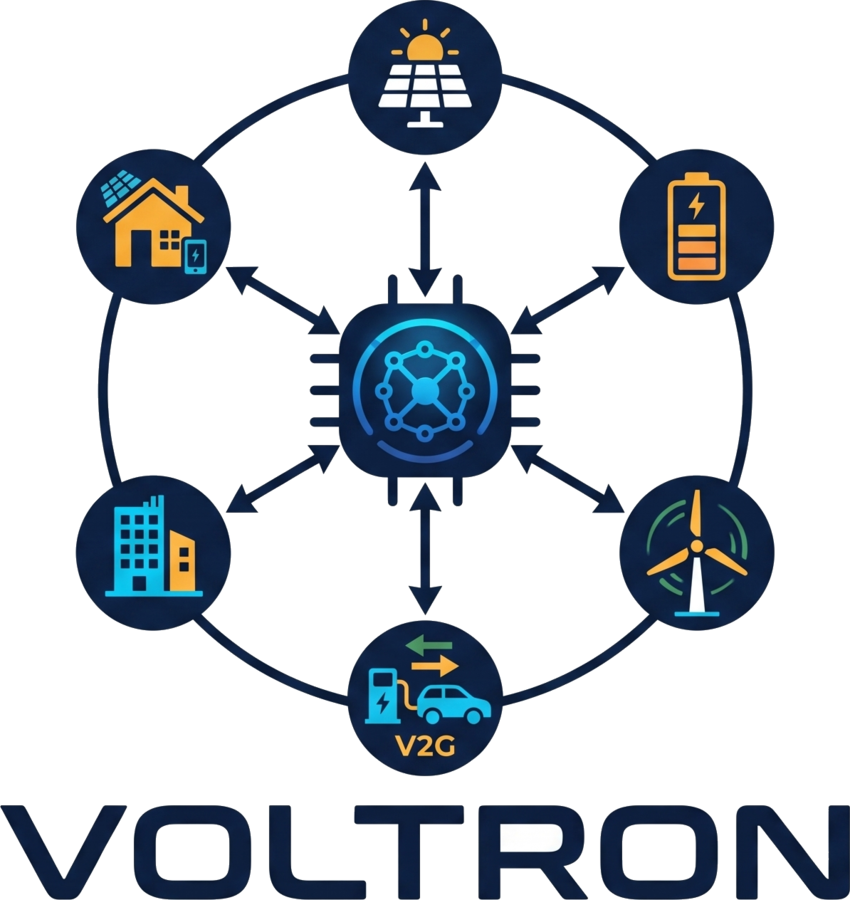
At each site, a Voltron edge gateway communicates directly with the local microgrid controller, streaming real-time telemetry to the Virtual Power Plant (VPP) on available dispatch capacity. Because export availability fluctuates throughout the day based on local site load and generation, the VPP continuously aggregates this data and reports total fleet capacity to Western Power. In turn, Western Power issues dynamic operating envelopes (DOEs) reflecting the VPP’s real-time grid export capability. For instance, if Western Power requests 5 MW sustained over four hours (20 MWh), the VPP orchestrates this target across the five sites based on current availability, continuously rebalancing the dispatch profile as each site’s load and generating capacity shift.
| Site | Can deliver (kW) | Allocated (kW) | Sent to the VPP in 4 h (kWh) |
|---|
Assumptions and changes from the source scenario
- The scenario starts from the 5 MW, 4 h, five-microgrid example in the project’s chat export F4-7. Site names and figures are illustrative. Every site is a Voltron microgrid, except Site B, the Shopping Centre, which has only solar and its own load.
- The source figures for three sites did not add up (150 x 10 kWh is 1.5 MWh, not 3.2 MWh; a 1.0 MW converter cannot export 1.0 MW and also carry a 0.1 MW load; 0.4 MW export plus 0.2 MW load for 4 h needs 2.4 MWh, not 2.2 MWh). Site figures here are chosen so each site’s power and energy add up. Total allocation is 5,000 kW, which is 20,000 kWh over 4 h.
- Firm capability is solar plus the battery’s output limit (usable energy / 4 h) minus EV charging and site load. The HVO genset is reported separately as reserve and starts only when the firm capability is used up. Energy is checked for the stated rate over 4 hours and not tracked as the battery drains.
- Site B’s solar array is 1,450 kW in the evening window shown. It exports what it is allocated and limits its solar to match. When the sun goes down in step 4b it has no capability and draws its 100 kW load from the grid.
- In CSIP-Aus a dynamic operating envelope is an export ceiling, not an instruction to export. A firm 5 MW delivery needs a contract or dispatch mechanism around it, and how per-site targets reach the gateway is still open (plan issue 28). The diagram shows it as a DERControl message from the VPP.
- Message names (DERStatus, MirrorMeterReading, DERControl) and the Modbus write (function code 16) follow chat exports F4-3 to F4-5 and F3-02. They are unverified claims, not read from a standard. The protocols shown are CSIP-Aus (IEEE 2030.5) as XML over HTTPS between the VPP and the Voltron, and Modbus TCP between the Voltron and the site controller. In CSIP-Aus the Voltron is the client: it posts telemetry and fetches controls on its own schedule. The reporting rate and any subscription option still need checking against SA TS 5573.
- Site E going off-line is detected by missed telemetry. The timeout the VPP would use is not specified in any source.
Sources: F4-7 scenario, F4-3 and F4-4 telemetry, F4-5 DOE example, F3-02 gateway to controller mapping, all in Voltron_Spec. Consolidated in Voltron_Spec_Consolidated_Summary.odt.